
Montalbano Centre Research Spotlight: Michael Daniels on Authentic Leadership

Are you an authentic leader or an authentic jerk? This provocative question is also the title of a recent article co-authored by Dr. Michael Daniels, Associate Professor in the UBC Sauder Organizational Behaviour and Human Resources Division and a thought leader at the Montalbano Centre for Responsible Leadership Development.
In the MIT Sloan Management Review article, Dr. Daniels makes the case that authenticity at work is more nuanced than popular advice suggests. Telling people to "bring their whole self" and "always be authentic" can tip into bluntness and rigidity without the right checks in place.
In this Q&A, Dr. Daniels breaks down the key ideas from the article, explains what unchecked authenticity looks like in the modern workplace, and reflects on the person in his life who embodies what an authentic leader really looks like.
How would you define authenticity?
MD: There are many different definitions of authenticity. Our approach in the article is simple: authenticity means staying true to what matters to us most. A useful question to ask is: are you walking your talk? The 'talk' is what we say matters to us, and the 'walk' is whether we're actually living it. Are our behaviors aligned with what we truly value?
Can you talk about your article in broad strokes?
MD: It's a conceptual article grounded in research my co-authors and I have done, but also in years of observing leaders in organizations and executive development programs.
The core idea is pushing back on an oversimplified cultural narrative: that authenticity is always positive and bringing your whole self to work is inherently virtuous. There's an unexamined version that gets promoted a lot, and it has real downsides for everyone involved. Bluntness is not the same as integrity and rigidity is not the same as being principled. This form of unchecked authenticity becomes a social liability that can damage your reputation and effectiveness as a leader, and ultimately stall career outcomes.
Humility is the crucial counterbalance. Pairing the two allows leaders to have conviction while still being open to challenge, feedback, and different perspectives. We end with a practical toolkit for what we call humble authenticity.
Can you elaborate on your choice of the word 'jerk' in the title?
MD: The co-authors had a back and forth about this. The honest answer is that we wanted a title that would grab attention and make people stop and think. We wrote this for people who already fashion themselves as highly authentic, and the risk for some of those people is that they come across as jerks without realizing it. Many people would readily answer yes to "are you an authentic leader?" The uncomfortable follow-up question is: are you sure you’re not sometimes an authentic jerk?
The underlying idea is that those are two different things. Good leadership requires authenticity, but a certain kind. The bad kind, the unchecked kind, is what you might call the authentic jerk.
What does 'bad authenticity' or an 'authentic jerk' look like in a workplace?
MD: It often shows up when someone equates authenticity with simply saying or doing whatever feels true to them in the moment. They’ll say, “I’m just being authentic,” or “I tell it like it is.” From their perspective, they’re demonstrating honesty and conviction. But to everyone else, it can feel like they’re shutting down conversation or dismissing other viewpoints.
It’s important to note that this isn’t typically coming from bad intentions. These are often people with strong values who genuinely care about doing the right thing. The problem is often that authenticity gets intertwined with ego. Instead of using their values to guide the conversation, they start using them to promote or defend their identity and what they call authenticity starts to become performative.
You want to be true to your values, but you don't need to be true to your ego.
You talk about the 'intent vs impact gap' in your article. Can you illustrate this with an example?
MD: There are attributional and moral biases that create a gap between how authentic you think you are and how authentic you actually come across. Research points to a surprising pattern: the more strongly people believe they behave according to their values, the less likely others perceive them as practicing what they preach. We’re all good at rationalizing our own behavior. If I say I value work-life balance but send emails at midnight during a busy week, I can easily convince myself that it was just an exception. But other people do the opposite — they notice the inconsistencies. The more I present myself as a champion of a particular value, the more closely others watch for the moments when I fall short of it.
Then there's the defensiveness that can follow. If someone points out that I wasn't perfectly in line with my values and I get defensive, observers attribute that to being even less authentic. Whereas if I say "you're right, I missed the mark" — the gap closes. When values are tightly tied to identity, it becomes harder to hear feedback about them.
In our previous conversation, we talked about one critical component that helps leaders acknowledge these gaps and remain open to challenge and feedback: humility. Humility moderates authenticity by encouraging leaders to recognize their limits and stay receptive to others’ perspectives.
It helps loosen that connection and quiet the ego so that values can guide our behavior without becoming a badge that we feel compelled to constantly hold up and defend. It allows you to stay open to the possibility that other people see things differently and that you might have something to learn.
How can leaders practically apply this in their workplaces?
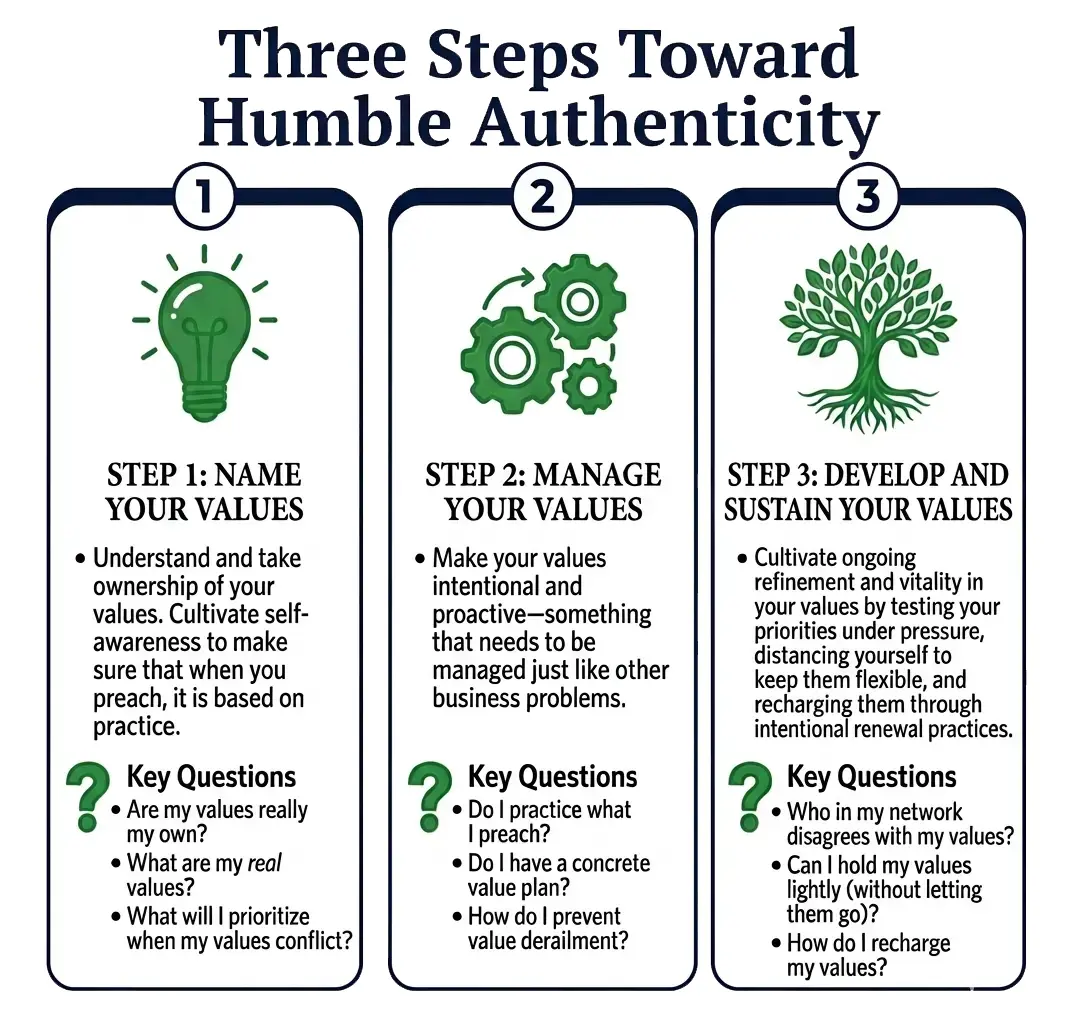
MD: The article offers a 3-step toolkit with prompts and exercises to help you develop a discipline of humble authenticity.
The first step is figuring out what your values really are. Are these truly my values, or did I pick them off a shopping list because they sounded good? Or are they values I inherited from my family or culture without me choosing them?
The second is understanding how well you're actually living those values. How much do you walk the talk?
The third is recognizing that values aren't static. They evolve over a lifetime. Can I hold my values with conviction but lightly enough to adjust them as I learn and grow? Humility unlocks all three steps. That's really the practical takeaway.
Is there someone in your life whose authentic leadership has made a mark on you?
MD: Honestly, I’ve seen this most clearly in mentors and teachers in my own life. I had a professor in my undergrad who was very confident in his ideas but also genuinely curious about what his students thought. He would hold his ground on positions he took in class but he was also willing to say, “That’s a good point. I hadn’t thought of it that way.” That combination of conviction and openness left a strong impression on me.